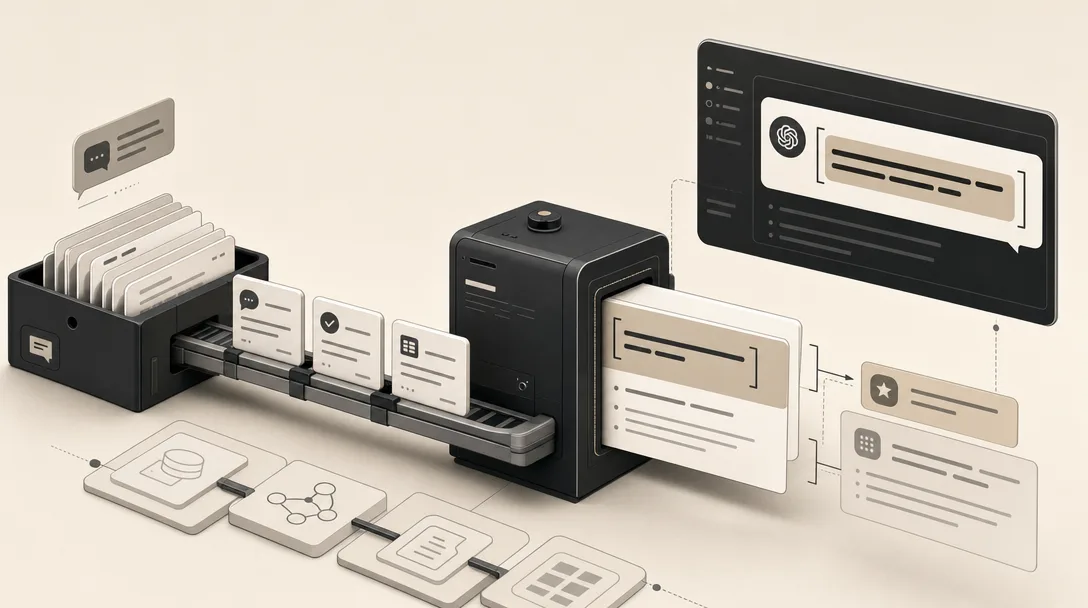
Why does a page rank well and still get skipped by an AI Overview?
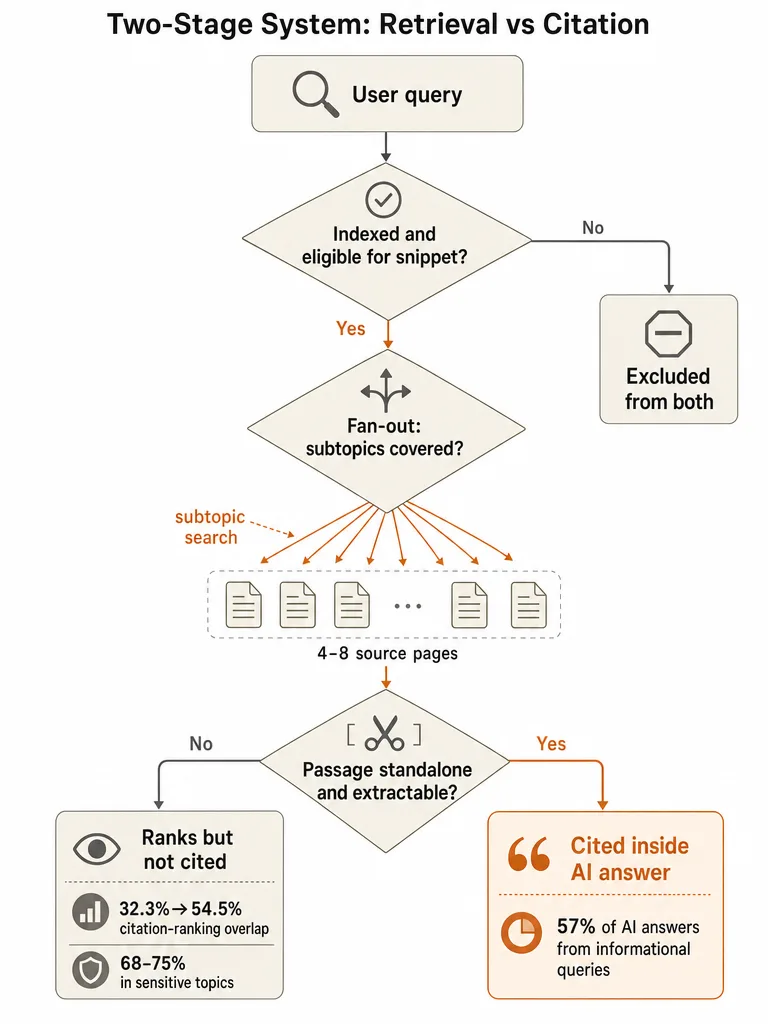
AI Overviews need self-contained, attributable answer passages placed near the top of a page, while classic SEO pages often bury the direct answer and spread supporting proof across long narrative sections instead. That gap is why ranking and citation diverge: AI Overviews versus classic SEO pages run on separate logic, not the same contest judged twice. Search Engine Land reports that the overlap between AI Overview citations and organic rankings, measured using BrightEdge data, grew from 32.3% to 54.5% between May 2024 and September 2025. Even at that high point, close to half of citations still went to pages that weren't in the top organic results for the same query.
The gap narrows unevenly by category. In YMYL topics such as healthcare, insurance, and education, Search Engine Land puts citation-to-ranking overlap between 68% and 75%, well above the all-category average. That pattern holds because retrieval in AI Overviews works differently than ranking: Google's systems pull the passage that answers a query most cleanly and verifiably, not necessarily the page carrying the strongest backlink profile or rank signals. A page sitting at position four with a tightly extractable answer can out-cite a page sitting at position one with the right fact buried three paragraphs down.
What does an AI Overview need from a page that classic ranking doesn't require?
An AI Overview is a Google-generated summary that sits above classic search results and synthesizes an answer from multiple web pages rather than pointing to one. Getting a page into that summary runs through two separate gates: retrieval eligibility first, citation selection second. Google Search Central's documentation on AI features says the same foundational SEO best practices used for Search overall, including helpful, reliable, people-first content, still apply to AI Overviews and AI Mode, and the technical bar for clearing the first gate is plain: a page must be indexed and eligible to appear in Search with a snippet, with no additional technical requirements beyond that.
Clearing retrieval isn't the same as getting chosen. Both AI Overviews and AI Mode, Google says, may use a "query fan-out" technique: issuing multiple related searches across subtopics and data sources before assembling a response. Google's models then identify supporting pages for that response, which is why AI Overviews often cite a wider and more diverse set of links than a classic page of ten blue links would ever show. Classic SEO stays necessary the whole way through, since it decides whether a page clears retrieval eligibility and meets Google's baseline quality bar at all. Citation selection, happening after fan-out, decides who gets quoted inside the generated answer, and that second decision adds extractability requirements that rank position alone doesn't measure.
What triggers an AI Overview instead of classic blue-link results?
AI Overviews trigger mainly on informational, multi-part, and conversational queries, and much less often on short transactional or narrow navigational searches. Search Engine Land puts the share of AI Overviews driven by informational queries at 57%, while Seobility, citing Semrush, puts the figure closer to 80% of triggering queries being informational. The gap between those two numbers reflects different measurement windows, but the direction is the same: questions that start with what, how, why, or when pull an AI Overview far more often than a short keyword search does.
Google is explicit that this is intentional rather than universal.
Multi-part questions that previously took several searches to resolve are, according to Google, the pattern AI Mode handles particularly well, which is one reason conversational and comparison-style queries skew toward triggering an overview rather than a classic results page.
Classic SEO pages vs AI-Overview-ready pages: what structurally differs?
Classic SEO pages and AI-Overview-ready pages diverge most in where the answer sits and how a claim gets proven, not in generic measures like word count or keyword density. No source in this space has published a rigorous, controlled side-by-side test of the two architectures, so what follows reads the available reporting plainly instead of dressing it up as a settled formula.
A page built for organic ranking often opens with a broad intro and saves the direct answer for several hundred words in. Search Engine Land's reporting on AI Overview retrieval says that when a retrieval system can't find the answer near the top of a page, it moves on to a page that puts it there instead, which is the most direct structural lesson the evidence supports: answer placement, not page length, decides whether a passage even gets considered.
The second supported difference is evidence format. Silktide's review of citation patterns found that AI systems favor passages that work as standalone answers, meaning the fact quoted inside an AI Overview tends to be discrete and verifiable rather than a loosely sourced narrative claim. A classic SEO page can carry the same fact; it usually just surrounds it with context the fact doesn't need to stand on its own.
Beyond those two points, claims about ideal heading phrasing or section length as citation drivers aren't something the current reporting backs up with evidence, so they're left out here rather than presented as settled practice. Rewriting a page for citation doesn't mean abandoning classic SEO; the two approaches share keywords, headings, and internal links. The difference that holds up is sequencing: the answer leads instead of trailing. For teams deciding which pages to rework first, AEO vs SEO: what B2B SaaS teams should change first walks through how to prioritize that rewrite against pages that already rank.
How do you structure an answer so AI systems can extract it without context?
Writing an extractable answer means every passage has to survive being lifted out of the page with no surrounding context. Silktide identifies this as the clearest pattern separating pages that get quoted from pages that get skipped. Four steps get a section there:
- Write the answer as a standalone claim. Open the section with a sentence that states the fact, verdict, or definition directly, the way Silktide's review found gets cited: a complete, verifiable assertion that doesn't lean on "it," "this," or the heading above it.
- Put the answer first, support second. Context, caveats, and examples belong after the claim, not before it. Retrieval systems scan the top of a section for the direct answer and move on if it's buried.
- Keep claim density high. Each sentence should carry one discrete, checkable fact, such as a number, a name, or a date, rather than a run of qualitative description that says little on its own.
- Match structured data to the visible text instead of treating it as a citation shortcut. FAQ, Article, and HowTo schema can describe what a passage answers, but Google Search Central ties AI feature eligibility to meeting Search's standard technical requirements generally, not to any particular schema type. Markup that doesn't match a page's visible text works against it; markup by itself doesn't guarantee a citation.
For a closer look at how Google's generative results selected and formatted answers before AI Overviews replaced them, what SGE was inside Google's Search Generative Experience covers the mechanics behind that shift.
How does query fan-out change which subtopics your page needs to cover?
Query fan-out means Google's AI systems issue multiple related searches across subtopics before assembling one response, so a page competing for a citation should cover the cluster of sub-questions around its main topic, not just the head term. Google's own documentation describes the mechanism directly: AI Overviews and AI Mode "may use a 'query fan-out' technique, issuing multiple related searches across subtopics and data sources to develop a response," with models identifying supporting pages for each of those subtopic searches, not just the original query.
Google doesn't publish exactly how that subtopic search maps onto page architecture, so what follows is a cautious operating assumption rather than a documented mechanism. If a head topic reliably generates related searches on pricing, setup, comparisons, or edge cases, it's reasonable to assume that a page answering all of those as clearly headed sections on one URL gives fan-out retrieval a single, complete source to pull from, instead of forcing it to stitch an answer together across several thin pages that each cover one sliver of the topic. Internal links, under that same assumption, are best used to connect a head-term page to genuinely separate topics, not to split one topic's sub-questions across competing URLs. Teams auditing an older blog for this kind of gap can start with a GEO content strategy for B2B SaaS sites with old blogs, which covers triaging which existing URLs to keep, consolidate, or retire.
How should you measure success when AI Overviews cut clicks but keep value?
AI Overview impressions and clicks show up inside Search Console's standard reporting, but that reporting doesn't isolate whether a given page was actually cited inside an AI Overview, so tracking citation presence itself still needs a separate workflow. Google says sites appearing in AI features are included in Search Console's overall traffic data under the "Web" search type, alongside classic results, which covers aggregate clicks and impressions but gives no line item for "cited in an AI Overview" versus "ranked below it."
That gap matters because the headline click-through numbers look grim in isolation: Terra reports that users shown an AI Overview click through to a traditional result only 8% of the time, compared with 15% for searches without an AI summary, a real compression in raw click volume.
Google's own framing complicates the "AI Overviews kill traffic" read. Google says clicks that do happen from a results page carrying an AI Overview tend to be higher quality, meaning visitors who arrive are more likely to spend more time on the site. That's consistent with how AI Overviews behave: the summary answers the casual browsers who just wanted the gist, and sends through the smaller group that wanted to go deeper. The practical move is to stop treating Search Console's click and impression totals as the full picture, and build a manual or tool-based check for citation presence itself, page by page, alongside session quality for the visits that do arrive. AI search content engine: what B2B SaaS teams need covers how that citation-tracking workflow fits into a broader content pipeline.