What does "SEObot writes 9 articles" actually mean?
The phrase "SEObot writes 9 articles" is not a verified product claim. None of the public SEObot sources — the SEObot homepage, its help center, the SEObot blog, TopTools, EliteAI, or Automateed — substantiate the number 9. What they do support is recurring article generation: SEObot describes itself as an autonomous SEO agent that researches a site, builds a content plan, and ships articles "every week" on autopilot (Source: SEObot).
So if you searched for "SEObot writes 9 articles," you are almost certainly looking at a comparison number someone else picked, not a product spec. The more useful question is not how many articles a tool produces in a sprint, but which articles. Nine articles that close taxonomy gaps, answer-engine prompt gaps, and citation gaps will outperform ninety articles that don't.
John Rush, who appears on the SEObot homepage, says he uses SEObot across 11 SaaS projects and 20 directories (Source: SEObot). That is a volume story. It is not a citation story. The rest of this guide separates the two — and shows where a recurring-article workflow ends and a citation-shaped blog engine begins.
What is the Link Hub, and what else does SEObot automate?
SEObot automates the classic SEO production stack: site and audience research, keyword research, content planning, weekly article generation, internal linking, images, and CMS publishing. The Link Hub is SEObot's internal-linking layer, which connects new articles to existing articles and site pages automatically (Source: SEObot).
Per its homepage and blog, SEObot's article output supports up to 4,000 words, YouTube embeds, AI-generated images, Google Images insertion, tables, lists, and what SEObot calls "anti-typo hallucination" controls. SEObot integrates with WordPress, Shopify, and Webflow, and the company says it writes in 50+ languages (Source: SEObot). EliteAI's listing says 48 languages — one of several inconsistencies covered later.
| Capability | What SEObot supports |
|---|---|
| Keyword & topic research | Yes — automated planning across site audience |
| Article generation | Recurring; up to 4,000 words |
| Internal linking | Yes — Link Hub across articles and site pages |
| Backlink building | Claimed on homepage; methodology not detailed in sources |
| Media | AI image generation, Google Images insertion, YouTube embeds |
| CMS publishing | WordPress, Shopify, Webflow listed |
| Languages | 50+ (SEObot) / 48 (EliteAI) |
The framing across SEObot's own materials is classic Google SEO: rankings, impressions, clicks, and CMS output. SEObot is built for blue-link search, not for citation in AI answer engines. That distinction matters more in 2026 than it did when the tool launched.
Are SEObot articles AI-only or human-edited?
SEObot can run fully on autopilot, but the public guidance from independent reviewers contradicts the autopilot pitch. EliteAI states that "everything is automated… it runs 100% autopilot by default," while still allowing users to take control and edit (Source: EliteAI). TopTools says SEObot offers "optional moderation controls" so users can review, approve, or decline drafts before publication (Source: TopTools). Automateed's review is more direct: SEObot "works best when its output is treated as a starting point rather than a final product," and users should still review, tweak, and make sure the content sounds like them (Source: Automateed).
The SEObot help center reflects the same tension. Its getting-started collection includes articles on whether output is AI-only or human-edited, how to edit an article, how to regenerate or delete one, and whether SEObot can rewrite an existing old article (Source: SEObot Docs).
Treat any AI blog generator's output as a draft, not a deliverable. That is true for SEObot, and it is true for any tool — including Mentionwell — that ships articles end-to-end.
How do I edit an article, ask for new headline ideas, and synchronize blog posts?
The SEObot operational workflow follows a standard sequence documented in the SEObot user guide (Source: SEObot Docs):
- Connect and sync the site. Verify the domain, link Google Search Console, and confirm the email used for SEObot matches the one on Search Console.
- Configure blog settings. Set tone, target audience, content rules, and CMS destination.
- Request or review headline ideas. SEObot generates a content plan; you can ask it to regenerate headline ideas inside the dashboard.
- Edit or regenerate an article. Use the article editor to revise sections, or trigger a full regeneration if the angle is off.
- Approve or decline. Optional moderation gate before anything goes live.
- Synchronize and publish. SEObot pushes approved articles to the connected CMS on schedule.
For workflow questions outside the docs (sample posts before purchase, GSC email matching, syncing edge cases), check the SEObot help center directly rather than third-party listings, which often paraphrase incorrectly.
What evidence supports SEObot's article-count, impression, click, pricing, and language claims?
The public numbers for SEObot conflict across sources, and none of them are accompanied by methodology. Here is the side-by-side:
| Metric | SEObot homepage | SEObot blog | TopTools | EliteAI |
|---|---|---|---|---|
| Articles generated | 200,000+ | 100,000+ | 200,000+ | — |
| Impressions | 0.6B | 0.6B | 1.2B | — |
| Clicks | 15M | 15M | 30M | — |
| Pricing | — | $19/month | From $49/month | — |
| Languages | — | 50+ | — | 48 |
Sources: SEObot homepage, SEObot blog, TopTools, EliteAI.
The article-count gap (100,000 vs 200,000), the impression gap (0.6B vs 1.2B), the click gap (15M vs 30M), and the pricing gap ($19 vs $49) suggest these numbers come from different snapshots, different cohorts, or different reporting layers — and the sources don't say which.
By our own arithmetic on the SEObot blog figures, 15 million clicks across 100,000+ articles averages roughly 150 clicks per article over an unstated time window. Without cohort size, attribution model, or Search Console proof, that average could just as easily mean a few hit articles carrying a long tail of zeros — a known pattern in scaled AI content.
What's missing for serious evaluation:
- Cohort size and measurement window — are these all-time cumulative, or last 12 months?
- Domain distribution — how many domains, and what's the median per-domain performance?
- Attribution model — Google Search Console, server logs, or self-reported?
- Survivorship — do these counts include de-indexed or deleted articles?
Inconsistent numbers across a vendor's own materials are not disqualifying, but they are a signal to ask harder questions before committing to scaled output. A domain scan that maps your AEO, GEO, and LLMO gaps before you buy article volume is a faster way to scope the right work — Get My Site GEO Optimized runs that scan in under a minute.
Does SEObot optimize for AEO, GEO, and LLMO, or mainly classic SEO?
Based on the public sources, SEObot optimizes primarily for classic SEO. The SEObot homepage, blog, and third-party listings describe keyword research, ranking outcomes, impressions, clicks, internal linking, and CMS publishing. They do not describe Answer Engine Optimization (AEO), Generative Engine Optimization (GEO), Large Language Model Optimization (LLMO), llms.txt, AI Overview citation targeting, or claim-level citation grounding.
Mentionwell takes the opposite starting point. Mentionwell positions itself as "an AEO, GEO, and LLMO blog engine" that "optimizes every article for AEO + GEO + LLMO + classic SEO at the same time" across ChatGPT, Claude, Gemini, Grok, and Perplexity (Source: Mentionwell). The features page is explicit: the four optimization layers are not optional — every article ships with all of them (Source: Mentionwell).
The practical difference shows up in three places:
- Citation structure. AEO and LLMO require direct-answer openings, attributed statistics, entity clarity, and citable phrases. SEObot's documented features focus on length, links, and media — not citation shape.
- Crawler access. LLMO requires a site-wide
llms.txt, per-article Markdown mirrors, and JSON Feed support. Mentionwell ships these by default; SEObot sources do not mention them. - Answer-engine baselines. GEO requires capturing prompts, fan-out queries, citations, and competitor gaps from AI engines themselves. SEObot does not describe this; Mentionwell does.
If your goal is rankings in Google's blue links, SEObot's classic SEO automation is on-thesis. If your goal is citation in ChatGPT, Claude, Gemini, Perplexity, or Google AI Overviews, the workflow needs AEO, GEO, and LLMO layers — not just classic AI SEO.
What's the difference between SEObot's recurring articles and Mentionwell's citation-shaped pipeline?
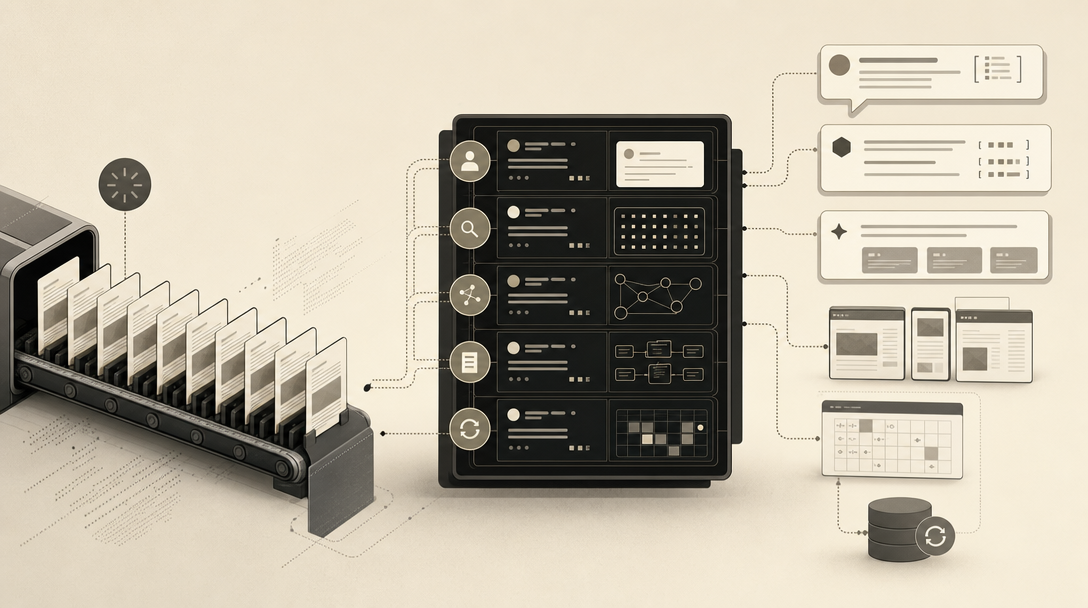
SEObot ships recurring articles. Mentionwell ships a citation-shaped pipeline. The operational difference is not one feature — it is the entire architecture.
Mentionwell's onboarding crawls the homepage, sitemap, robots.txt, and structured data; detects framework, blog path, and CMS signals; writes a starter brand profile; builds a content taxonomy; and seeds 10 starter headlines in a 60-second job (Source: Mentionwell Docs). An approved first draft lands in roughly 60–90 seconds. Every article then runs through an 11-stage pipeline with section-by-section writing and grounded citations (Source: Mentionwell).
| Stage | SEObot (per public sources) | Mentionwell |
|---|---|---|
| Onboarding | Connect site, set blog config | 60-second domain scan; brand profile; taxonomy; starter headlines |
| Research | Keyword research, audience research | Research + GEO baseline (prompts, citations, fan-out queries, competitor gaps) |
| Outline | Content plan, headline ideas | Outline grounded in research synthesis and citation gaps |
| Drafting | Article generation, up to 4,000 words | Section-by-section writer with grounded citations |
| QA | "Anti-typo hallucination" mentioned | Editorial critic; duplicate-section and template-leak checks |
| Metadata | Standard SEO fields | Metadata + FAQPage + Article JSON-LD |
| Media | Images, Google Images, YouTube embeds | Image generation tied to brand image style |
| Citation layer | Not described | AEO + GEO + LLMO layers on every article |
| Publishing | Push to WordPress, Shopify, Webflow | API pull, CMS push (WordPress, Webflow, Ghost, Shopify, Notion), Markdown mirror, llms.txt |
Mentionwell can run a GEO baseline across AI answer engines, capture prompts, citations, fan-out queries, cited-page claims, and competitor gaps, then inject that context into article creation.
That GEO baseline is the structural difference. SEObot picks topics from keyword research. Mentionwell picks topics from keyword research plus the actual prompts and citation gaps observed across AI engines. The article set ends up shaped by what answer engines are asking, not just what classic search ranks for. Mentionwell was built by ZipLyne, an AI-product agency, out of internal tooling now shipping as a standalone product (Source: Mentionwell).
Which CMS, headless, API, and structured-data options matter for your stack?
Choose your delivery model before you choose your generator. SEObot lists CMS integrations including WordPress, Shopify, and Webflow (Source: SEObot blog). Mentionwell supports a broader delivery surface — pull, push, commit, or shove — across WordPress, Webflow, Ghost, Shopify, and Notion, plus a public read-only API and the mentionwell-reader npm package for headless consumption (Source: Mentionwell).
The structured-data and feed surface is where the gap is largest:
- Article JSON-LD and FAQPage JSON-LD — required for rich results and frequently used by AEO crawlers. Mentionwell ships both on every article.
- RSS, JSON Feed, sitemap — standard discovery channels for crawlers including LLM training pipelines. Mentionwell ships all three.
- Per-article Markdown mirror — a clean, parseable copy at a stable URL. LLM crawlers prefer Markdown over rendered HTML.
- Site-wide llms.txt — the emerging standard for declaring AI-crawler-readable content. Covered in our llms.txt explainer.
If you run a headless stack — Next.js front-end, separate content layer — the read-only API matters more than CMS push. If you run WordPress or Webflow with editors who want to review in their CMS, push delivery matters more. Pick the delivery model that matches how your team already publishes; do not rebuild the stack to match the tool.
How should teams avoid thin programmatic SEO pages and duplicate generated sections?
Programmatic content fails in two ways, and they are different problems. Mentionwell's framing is useful: classic programmatic SEO is template + data → many pages, while programmatic generative content is model + data → many genuinely different pages (Source: Mentionwell). The first risks thinness. The second risks hallucination.
Both fail Google's helpful-content standards. Both fail AI-engine citation. The safeguards are operational, not cosmetic:
- Taxonomy-led selection. Choose article slots from a real content taxonomy, not from keyword volume alone. This prevents doorway pages.
- Grounded sources. Every factual claim should trace to a research source captured during generation. This prevents hallucination.
- Duplicate-section detection. Scan drafts for repeated sections across articles. Mentionwell's editorial critic flags duplicate sections and template leak (Source: Mentionwell).
- Template-leak checks. Look for variable-style phrasing ("In [city], the best [service] is…") that signals a template was filled, not written.
- Editorial critic review. A model-driven critic that reads the draft and flags weak openings, missing citations, and shallow sections.
- Refresh loops. Schedule archive refreshes so older articles get updated facts, new entities, and current citations.
How should readers separate SEObot from traffic-bot and AI-tool SERP noise?
SEObot is a content automation tool, not a traffic-manipulation bot — and the SERP for "SEObot" mixes the two categories together. SEObot (also written SEO Bot) generates articles and pushes them to a CMS. Tools like Somiibo, Botsify, and Clawdbot that show up in adjacent results are typically traffic, chat, or session-manipulation bots, which is a different category and usually a Google-policy risk.
Other entities that surface in SEObot-related searches — Journalist AI, AI Rank Lab, and stray names like Vitalik — are either separate AI content tools or unrelated index noise. Treat them as disambiguation, not as comparables. If a tool's pitch is "more traffic" without explaining whether the traffic is human or automated, it is not in the same category as a content automation engine.
When is article-volume automation enough, and when do you need a citation-shaped blog engine?
Choose by job, not by feature count. SEObot is a fit when the job is recurring classic SEO articles, internal links, AI images, YouTube embeds, and CMS publishing into WordPress, Shopify, or Webflow — and when the success metric is Google rankings.
A citation-shaped engine like Mentionwell is the fit when any of these are true:
- You need AEO, GEO, LLMO, and classic SEO on every article — not as separate workflows.
- Your audience increasingly finds answers in ChatGPT, Claude, Gemini, Perplexity, or Copilot, not just Google.
- You operate multiple sites or client domains and need brand-consistent output at scale.
- You publish into a headless stack and need a read-only API plus per-article Markdown mirrors.
- Your archive is fragmented and needs scheduled refreshes, not just new posts.
- You want article selection driven by observed prompts, fan-out queries, and citation gaps — not just keyword volume.
Pre-purchase checklist for either tool:
- Request three sample posts in your industry. Read them as a buyer, not a publisher.
- Check citation shape. Does each section open with a direct answer? Are statistics attributed?
- Audit the structured data. View source on a sample article URL and confirm JSON-LD ships.
- Test crawler access. Look for
llms.txt, sitemap, and Markdown mirrors. - Verify the editorial gate. Confirm you can review, edit, regenerate, or decline drafts.
Mentionwell was built specifically for the citation job — onboarding crawls your domain in 60 seconds, builds a brand profile and taxonomy, and ships AEO + GEO + LLMO + SEO articles end-to-end through an 11-stage pipeline with grounded citations and editorial critique. If your next nine articles need to land in AI answers, not just rankings, Get My Site GEO Optimized and see the pipeline run on your domain.
Sources
- Content Writers Are DEAD! This AI Automates SEO Writingwww.youtube.com